Electromagnetic sobriety in schools: what if Wi-Fi were only activated when truly needed?
24 Nov 2026
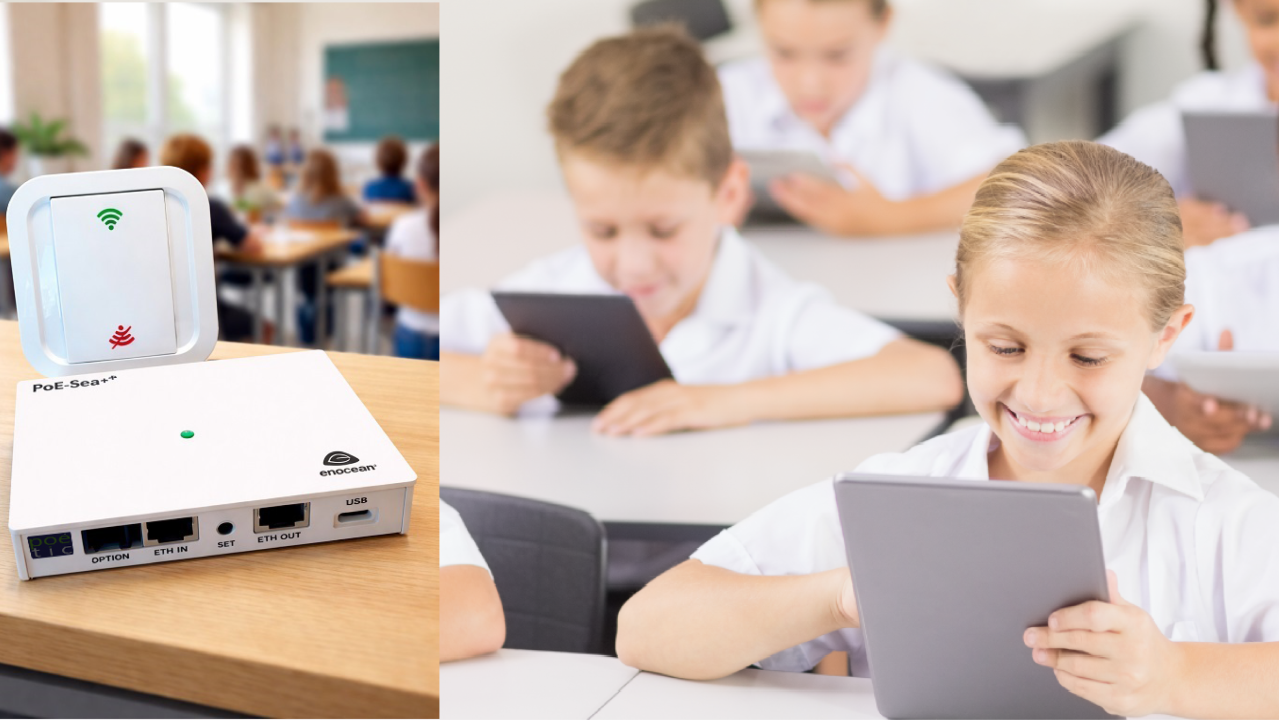
In this article, Dominique Le Bourse advocates for a reasoned use of Wi-Fi in primary schools. It is not about giving up digital technology, but rather activating Wi-Fi only when educational activities require it. The article highlights the precautionary principle, the specific vigilance required for young children, the 2015 Abeille Law, and recommendations from ANSES. It also deplores the widespread lack of awareness of this regulatory framework on the ground. Finally, it introduces PoE-Sea+®, a controller enabling teachers to activate Wi-Fi on demand, offering energy savings, enhanced cybersecurity, and educational environmental sensors.
Digital technology in schools, yes – but with discernment
Tablets, online resources, collaborative tools: digital technology is now part of everyday school life. In most classrooms, Wi-Fi remains the simplest solution for connecting devices without multiplying cables.
Li-Fi could represent an interesting alternative, without radiofrequency emissions. However, its cost and limited integration into tablets still restrict its deployment.
Why talk about precaution?
Regulatory limits applicable to radiofrequencies are primarily designed to prevent thermal effects—that is, tissue heating linked to high-power emissions. For Wi-Fi, research also focuses on potential non-thermal effects at low exposure levels, particularly in relation to signal polarization and pulsation.
Several questions remain to be studied: possible interactions of polarized signals with cellular structures, the effects of signals pulsed at 10 Hz, and their potential influence on concentration or sleep onset through a resonance effect on the brain's alpha waves (8–12 Hz).
- Which biological mechanisms could be involved?
- Would these mechanisms have a measurable effect on health?
- What are the possible consequences for sleep, attention, or concentration?
To date, the scientific debate remains open and calls for a clear distinction between hypotheses, early warning signals, and proven risks.
No scientific study currently establishes that the waves emitted by Wi-Fi pose a proven danger, even a minor one. However, this lack of proof does not preclude a simple approach: reducing emissions when they serve no educational purpose.
Why pay special attention to young children?
Children exhibit characteristics that warrant specific vigilance: a different morphology from adults, a developing nervous system, and cumulative exposure likely to span their entire lives.
- Morphology: a thinner skull and brain tissues richer in water and ions can alter the penetration and absorption of radio waves.
- Development: the central nervous system is still maturing and cells are actively dividing.
- Duration of exposure: children today are exposed to radiofrequencies from a very young age, even in utero.
What the legal framework provides
In 2015, the French Parliament adopted a precautionary approach: when faced with potential serious yet scientifically uncertain harm, implementing provisional, proportionate, and reviewable measures.
Thus, the Abeille Law No. 2015-136 of February 9, 2015 prohibits Wi-Fi in spaces dedicated to children under three years of age (nurseries, daycare centers). An office or technical room may nevertheless be equipped with Wi-Fi, provided no infants stay there. In primary schools, it remains authorized, but must be deactivated outside of educational activities. The school council must be informed prior to installation work, and a pictogram must be displayed at the entrance of the establishment.
Decree No. 2025-1165 of December 5, 2025 on the digital reference framework for education provides another point of support. Although its mandatory nature applies to secondary education, the French Ministry of Education's Wi-Fi Reference Guide offers useful best practices for municipalities, which are responsible for equipping primary schools.
An alarming lack of awareness on the ground
Despite coming into force in 2015, the Abeille Law remains unknown to the majority of those most concerned. Whether among parents, teaching teams, school principals, municipal IT managers, or local elected officials, the existence of this legal framework and the recommendations of the Wi-Fi Reference Guide still too often escape day-to-day decision-makers.
It is urgent to bridge this collective gap and encourage public officials (ministries, high commissions, etc.) to reiterate the importance of upholding this precautionary principle—which should not be seen as a barrier to digital technology, but as a basic public health reflex to protect children's health. See the stakeholders and institutions concerned at the end of the article (*)
Recommendations from ANSES
The French Agency for Food, Environmental and Occupational Health & Safety (ANSES) notes that, below regulatory thresholds, no proven health effect has been demonstrated for Wi-Fi, but confirms possible biological effects that call for moderation among the youngest children.
To apply this precautionary principle without hindering digital uses, the guidelines are straightforward:
- Prioritize wired connections for all stationary equipment.
- Systematically switch off wireless access points outside of educational activities.
- Keep Wi-Fi transmitters away from areas of prolonged occupancy.
- Ensure full transparency regarding the presence and activation of networks.
The goal is not to give up technology, but to shift from Wi-Fi emitting 24/7 by default to controlled, on-demand usage.
From field observation to a concrete solution
In 2019, a teacher alerted the founder of PoE-Tic to a very practical challenge: how can electromagnetic sobriety be applied when a teacher cannot simply switch off the Wi-Fi in their own classroom?
Realizing that no simple solution existed to meet this need, Dominique Le Bourse founded PoE-Tic at the end of 2019. Its mission: to design devices enabling schools to better manage their Wi-Fi installations and facilitate compliance with the Abeille Law.
PoE-Sea+®: activating Wi-Fi on demand
Simple operation
PoE-Sea+® is a controller dedicated to electromagnetic sobriety in primary schools. Installed between the network port and the Wi-Fi access point, it enables the teacher to activate the connection only when an educational activity requires it.
Control is operated via a self-powered, wireless, and battery-free switch: a local, immediate action that easily integrates into daily classroom routines.
Based on EnOcean technology, the architecture allows rapid installation, data encryption, and local or centralized management by an IT department for Wi-Fi access point maintenance.
Download the PoE-Sea+® brochure (PDF)
Energy savings – cybersecurity and controlled connected usage
A Wi-Fi access point activated for an average of 2 hours per day during the school year yields savings of €25.00 per year compared to an access point running continuously.
Restricting Wi-Fi access to educational activities strengthens IT network security by significantly reducing hacking risks.
Teachers have the autonomy to decide connection times, thereby shielding young students from unwanted connections.
A tool that can also support ecological transition education
Beyond controlling Wi-Fi emissions, the solution can help reduce energy consumption and integrate all types of EnOcean environmental sensors: CO₂, temperature, radon, occupancy detection, and energy consumption monitoring.
Displayed as charts, this data becomes a tangible teaching aid with measurements specific to the classroom or school. Students can thus observe the impact of simple actions—airing out the classroom, turning off lights during the lunch break—on air quality and energy consumption.
To learn more about deploying switchable or on-demand Wi-Fi, as well as our PoE-Sea+® product range:
Contact us and explore the PoE-Sea+® range on poe-sea.fr